How a Quiet Elder in My Family Helped Me Stop Feeling "Crazy," Regain My Emotional Clarity, and Finally Recognise the Hidden Behavioural Patterns of a Husband Living a Double Life

If you have been feeling like something is deeply wrong in your marriage — but every time you try to explain it, your husband makes you feel like the problem is you — read every word on this page.
If you catch yourself rehearsing conversations in your head before you have them.
If you ask a simple question and somehow end up apologising by the end of it.
If you feel confused, anxious, and emotionally exhausted — not sometimes, but constantly.
If people around you say you are "too sensitive" or "overthinking" — but your body knows that what you are sensing is real.
If you have tried talking to him. And nothing changes. And then you try again. And still nothing changes. And now you are starting to wonder if maybe it really is all in your head.
It is not in your head.
You are not "too much." You are not "crazy." You are not imagining things.
What you are experiencing has a name. It has a pattern. And once you see the pattern — once you really see it — you will never unsee it again.
But here is what nobody tells you: the real pain is not the confusion itself. The real pain is what that confusion is doing to you. To your peace. To your self-worth. To the woman you used to be before you started doubting yourself.
You used to trust your own mind. Now you question every thought you have.
You used to feel confident in your own home. Now you feel like a guest walking on eggshells.
You used to know who you were. Now you are not sure.
And that is the most devastating part of all of this. Not the distance. Not the secrets. Not even the lies. It is the slow erosion of your own self. The way you have been slowly, quietly talked out of your own reality.
I know. Because I carried it too.

My name is Nnena.
I am not a therapist. Not a marriage counsellor. Not a psychologist with a certificate hanging on a wall.
I am just a woman who spent four years living inside the very confusion you are feeling right now.
I grew up in Enugu. I married at twenty-nine — a man I had known for three years, a man who was charming and attentive and who made me feel, for the first time in my life, truly chosen.
The changes came slowly. So slowly that for the first year, I did not even notice them. He became busier. His phone became private. His answers became shorter. His explanations became vague — just vague enough that I could not pin anything down, but just wrong enough that something in my stomach kept pulling at me.
I went to our pastor. He told me to pray and be patient.
I spoke to my older sister. She told me all men go through phases.
I bought books on marriage. I read blogs. I changed how I talked to him, how I dressed, how I cooked, how I behaved in the bedroom — convinced that if I just became a better wife, the man I married would come back.
Nothing worked.
Because nothing I was doing was addressing the actual problem.
And no one around me — not the pastor, not my sister, not a single book I read — could tell me what the actual problem was.
The worst part was not the loneliness. The worst part was the way I had stopped trusting myself. I would notice something — a look, a lie, an inconsistency — and before I could even process it, I would already be talking myself out of it. Maybe I misheard. Maybe I am overreacting. Maybe I am the problem.
That is what four years of unexplained behaviour does to a woman. It does not just damage the marriage. It damages the woman inside it.
The Day Everything Changed
It happened at my cousin's introduction ceremony in Awka. One of those full-family events — chairs arranged in rows, the women in matching aso-ebi, the elders seated at the front with their authority worn quietly on their faces.
In Igbo tradition, these ceremonies are sacred. The whole family comes together — not just to witness a union, but to speak life over it. The elders say what must be said. The young ones listen.
I had gone without my husband. He had a "work commitment." His third "work commitment" in as many family events.
I sat with the women and smiled and answered questions and pretended that everything in my marriage was fine. Because that is what we do. We carry our pain quietly. We perform peace.
But one of the senior women at the ceremony — a woman named Mama Chidinma, who is in her late seventies and has lived more life than most of us will ever understand — she looked at me across the room with eyes that saw straight through the performance.
She did not say anything then. She just looked at me. And I looked away. Because something in her gaze knew exactly what I was hiding.
Later that evening, as the gathering was winding down and the younger women were clearing plates, Mama Chidinma appeared beside me quietly.
She touched my hand.
"Walk with me," she said.
I have never been more ashamed in my life — because in that moment, I realised that my pain, which I thought I had hidden so perfectly, had been visible all along.
The Discovery That Changed Everything
We sat away from the others, under a tree at the edge of the compound. She did not ask me questions. She simply began to talk. And the way she talked — quietly, firmly, without drama — told me she had seen this before. Many times.
She looked at me and said five words I will never forget:
"You are not going mad."
I started crying immediately. Not the polite kind of crying. The kind that comes from somewhere deep — from years of holding something too heavy for too long. She waited until I finished.
Mama Chidinma: "These days, women are spending money on counsellors who ask plenty of questions but cannot tell them what they are actually seeing. They go to church and are told to submit more. They change themselves — their cooking, their body, their behaviour — as if the problem is inside them. But nobody is teaching them how to see. How to look at a man's behaviour — not his words — and understand what it is telling them. Our grandmothers knew this. They did not need therapy. They knew how to read patterns. We have lost that knowledge."
Then she leaned closer and explained something that rearranged everything I thought I understood about my situation.
Mama Chidinma: "A man who is living two emotional lives does not behave randomly. His behaviour follows a structure. It has patterns — withdrawal here, overcompensation there, deflection when you get close, sudden warmth when he needs to cover a gap. It is not chaos. It is a system. And once you learn to recognise the system, the confusion disappears. You will not be guessing anymore. You will be seeing."
Here is the core truth that nobody in your circle is telling you:
Your confusion is not a personal failing. It is a predictable response to a very specific set of behavioural patterns. When a husband is living a double emotional life, his behaviour creates a system — a cycle of withdrawal, deflection, overcompensation, and distortion — that is specifically designed (whether consciously or not) to keep you off-balance.
Your mind is not broken. It is responding exactly as any rational mind would respond when the information it is receiving keeps contradicting itself. The confusion is not yours. It is being manufactured.
And the moment you learn to see the pattern — not the individual incident, but the pattern — everything becomes clear. Not necessarily easier. But clear. And clarity is the first step back to yourself.
Mama Chidinma: "He is not one man behaving badly. He is two men — one for you, one for somewhere else. And the exhaustion you feel is from trying to hold a relationship with a person who is never fully present. You are not confused because you are weak. You are confused because you are dealing with something that was designed to confuse you."
I sat there under that tree and felt something shift inside me.
Four years. I had spent four years believing the problem was me. Adjusting myself, shrinking myself, blaming myself — when all along, what I was experiencing had a name. A structure. A recognisable pattern.
It took one woman, in a quiet corner of a family compound, to tell me what was actually happening.
What Mama Chidinma described was not complicated. It did not require expensive therapy or a marriage retreat or any kind of dramatic confrontation. It was simply a method of observation — a way of looking at behaviour patterns clearly, without emotion clouding the view. A way of gathering clarity before taking any action.
Simple. Quiet. Done privately, in your own time, in your own home. No confrontation required. No drama. Just pattern recognition — and the emotional clarity that follows it.
Mama Chidinma: "Learn it exactly as I will explain it. Do not skip steps. Sit with what you see. And when the clarity comes — and it will come — just breathe. Because you will finally know what you are actually dealing with."
The First Few Days: Nothing
She spent an hour with me that evening, explaining the framework she called the Split-Life Behaviour Pattern. I went home and I began to apply it.
Day 1. I watched. I noted. Nothing dramatic happened. I almost dismissed the whole thing as wishful thinking.
Day 2. I almost stopped. My husband was acting completely normal. I started to wonder if Mama Chidinma had simply been a kind old woman telling me what I wanted to hear.
Day 3. He did something small. An inconsistency — the kind I had noticed hundreds of times before and talked myself out of. This time, instead of dismissing it, I noted it. Just noted it. No confrontation. No accusation. Just: I see this.
Day 4. Another small thing. Different from Day 3. But the same category of pattern. I felt the first flicker of something I had not felt in years.
Certainty.
Not anger. Not grief. Certainty. The quiet kind that comes when a blurry image finally comes into focus.
Day 5: The First Sign
By Day 5, I could see it.
Not everything. Not the full picture. But the structure was beginning to appear — like looking at a puzzle and suddenly realising you can see the shape of the image even before all the pieces are in place.
The withdrawal pattern. The deflection pattern. The overcompensation that always — always — came exactly forty-eight hours after a period of emotional distance.
I had lived with these patterns for four years and never seen them as patterns. I had only ever seen them as incidents. Random, confusing, emotionally destabilising incidents.
That was the first sign. Not a dramatic revelation. Just a quiet, devastating recognition: I can see this now. I can actually see it.
Day 6. Day 7. Then Something Broke Open.
Day 6, the picture sharpened further.
Day 7, I saw the overcompensation cycle play out in real time — exactly as Mama Chidinma had described it. It was almost textbook. If I had not been looking for it, I would have melted into it the way I always had. Instead, I watched it happen. Calmly. Clearly.
By Day 8 — and this is the part that still gets me — I forgot to do my morning observation check.
For a woman who had been anxiously monitoring her marriage every single morning for four years, forgetting to check was the most profound evidence that something had healed. Not in him. In me.
I had stopped being consumed by it. Because I was no longer confused by it. And when confusion leaves, the obsession leaves with it.
But the real test was yet to come.
Friday Night
A week and a half after that evening in Awka, my husband reached for my hand across the dinner table.
In the past, I would have felt that familiar mixture of relief and anxiety — relieved because he was being warm, anxious because I never knew how long it would last or what it meant or what I had done differently to earn it.
This time was different.
I let him hold my hand. And instead of getting lost in the warmth of it — instead of letting it convince me of something — I simply noticed where in the pattern this moment was falling. The warmth after the distance. Right on schedule.
That night, for the first time in longer than I can remember, I was present in my own home. Not performing. Not anxious. Not trying to manage his mood or read his expressions or prepare for the next confusion.
I cried afterward. In the bathroom, quietly, with the tap running.
Not from sadness. From relief. Because the woman who had been slowly disappearing for four years was beginning to come back. And she was coming back not because her marriage had magically fixed itself — but because she could finally see clearly. And a woman who can see clearly is a woman who can decide for herself what to do next.
He looked at me later that night and said I seemed different. Calmer. I told him I was. I was not wrong.
I Didn't Plan to Tell Anyone
I went back to Mama Chidinma two weeks later. I told her what I had observed. She listened carefully and then said something that has stayed with me:
"Now you know what you are dealing with. Now you can decide."
I did not plan to share any of this. It felt too personal. Too private.
But then I told one friend. Just one. A woman in Lagos who I had watched struggle with her own marriage for years. I described what I had learned — the framework, the pattern categories, the observation method. I told her about Mama Chidinma.
She was silent for a long moment. Then she said: "Nnena. That is exactly what is happening to me. Exactly."
Within three weeks, she had shared it with two other women in her circle. Voice notes. WhatsApp messages. Woman to woman to woman.
And then the messages started coming to me directly.
"I had gone to three different counsellors in two years. Not one of them used the word 'pattern.' They all focused on communication — on how I was saying things wrong. Nnena's framework was the first thing that made me feel like I was not the problem. Within a week of applying it, I could see things I had been staring at for years. I cannot explain the relief."
"My husband always said I was overthinking. Always. For twelve years I believed him. Then I read this and I cried for two hours — because it described my life chapter by chapter. I started the observation method and by Day 6 I had seen the withdrawal-overcompensation cycle twice. Twice in six days. I had never connected those two things before. Now I cannot unsee it."
"I was days away from leaving my marriage without fully understanding what had happened to it. This framework gave me something I did not have — clarity. Not about what decision to make. About what I was actually seeing. That is what I needed first. Everything else came after."
"What got me was the part about how confusion is manufactured. I had never thought of it that way. I thought my confusion was my weakness. Learning that it was a predictable response to a specific pattern — that alone changed something in my chest. I felt less ashamed. Less broken. And that gave me the clarity to start observing instead of reacting."
"Sixteen years. I have been carrying this for sixteen years. This guide is the first thing that has spoken directly to my experience — not in a general 'marriage is hard' way, but specifically. The deflection pattern. The financial vagueness. The way warmth always comes right after distance. I had normalised all of it. I did not even know what I was normalising until I read this."
"I kept being told I was 'too young to be worried about these things.' But I knew something was off from the first year. The framework confirmed what my instincts were already telling me — and gave me language for it. Language I can now use when I speak to him. Calmly. Without sounding 'crazy.'"
Same framework. Same method. Same pattern recognition. Same results.
Why I Am Sharing This
I went back to Mama Chidinma one more time. I told her what was happening — how many women were reaching out, how far the voice notes had spread.
She laughed. A quiet, knowing laugh.
I asked her permission to document what she had taught me — to write it down formally so that any woman, anywhere, could access it.
She thought about it for a moment. Then she nodded.
Mama Chidinma: "Do it. But make sure they follow the method exactly — not halfway. And make sure they understand one thing: they were never going mad. They were simply trying to make sense of something that was designed not to make sense. Tell them that. That is the first thing they need to hear."
So I documented everything. Every framework. Every pattern category. Every observation method. Every conversation technique. And then I had it properly verified, written in plain language, and organised into a guide that any woman can use — tonight, at home, without needing a therapist or a counsellor or anyone else's permission.
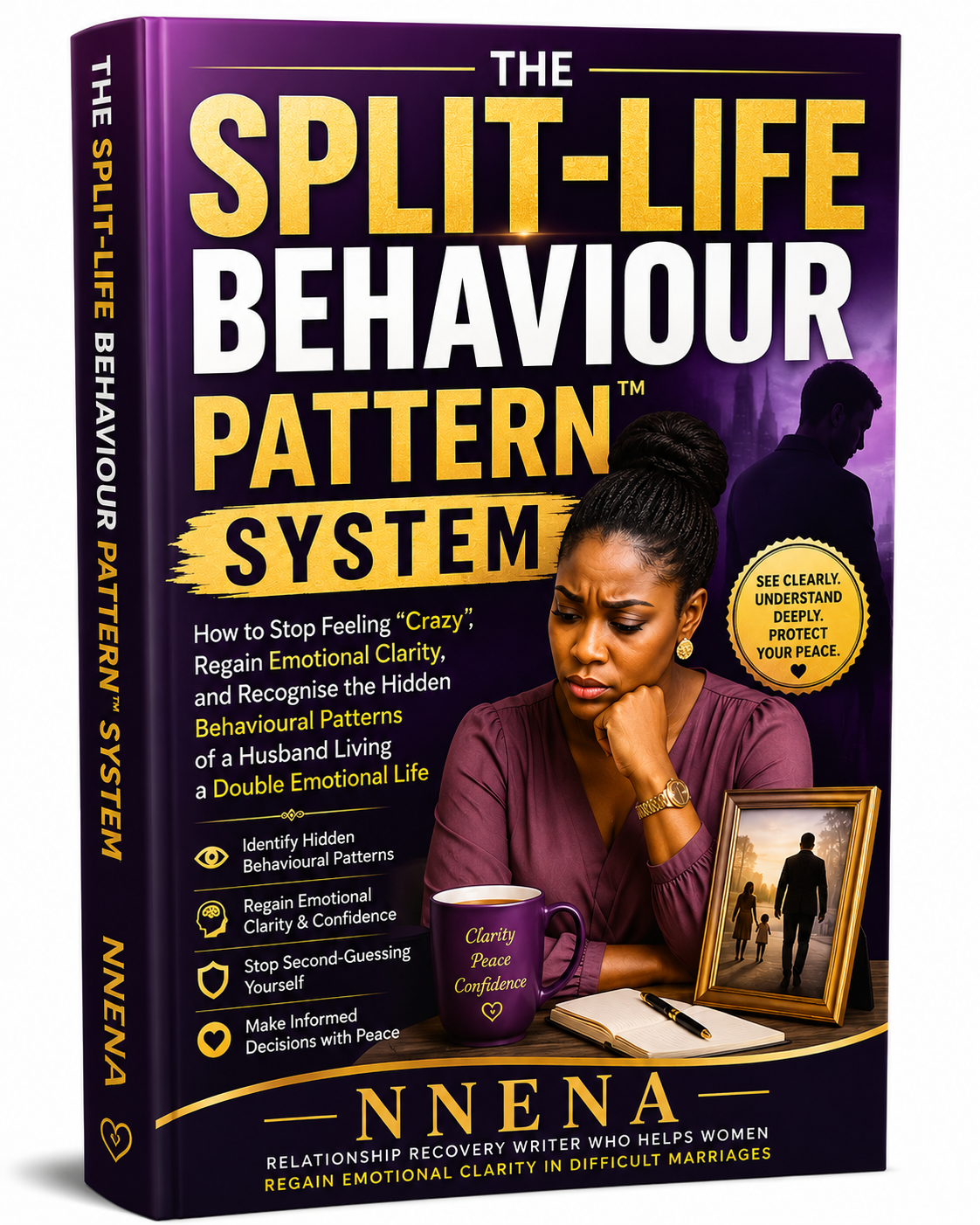
Everything Mama Chidinma taught me — documented, verified, written in plain language, so you can begin tonight from the privacy of your own home. No therapist required. No confrontation required. Just clarity.
- The Split-Life Behaviour Pattern™ Framework — The complete pattern-recognition system that reveals how a double emotional life actually behaves. The four core pattern categories explained in detail. (Pages 8–31)
- The Observation Method — The exact step-by-step daily process for documenting what you are seeing without getting emotionally overwhelmed. How to observe behaviour, not words. (Pages 32–44)
- The 7 Specific Pattern Markers — The exact behavioural signals that distinguish a man living a split emotional life from one who is simply going through a difficult season. Includes real-life examples. (Pages 45–62)
- The #1 Mistake Women Make — Why confronting without clarity always backfires, and what to do instead. The approach that gives you information without starting a war. (Pages 63–70)
- The Clarity Accelerator — A food, routine, and lifestyle list of the things that are keeping you emotionally foggy — and what to replace them with to sharpen your perception. (Pages 71–78)
- Hidden Enabling Habits — The daily habits most women do not realise are making them more vulnerable to confusion and manipulation. How to break them quietly. (Pages 79–87)
- The Monthly Maintenance Check — A simple ongoing practice for women who want to stay emotionally grounded long-term, regardless of what their marriage does or does not do. (Pages 88–94)
- The Extended Protocol for Severe Cases — For women who have been in the confusion for five years or more. A deeper framework for rebuilding emotional clarity when the erosion has been long-standing. (Pages 95–112)
You do not need to travel anywhere. You do not need to see anyone. You do not need any specialist equipment. Everything in this guide can be applied from your own home, in your own time. Total cost of materials? Zero. Everything you need is already inside you — this guide simply teaches you how to access it.
Compare That To What You Have Already Been Spending
How Much Does This Guide Cost?
Before I tell you the price, let me show you what it cost me to create it.
- Professional documentation and writing₦45,000
- Research and framework verification₦28,000
- Editing and plain-language formatting₦18,000
- Guide design and layout₦22,000
- Delivery technology setup₦15,000
- Testing with real women across NigeriaPriceless
A fair price for access to this framework would be ₦25,000. That is less than one counselling session for information that most counsellors have never even heard of.
But I know times are hard. And I know the women who need this most are often the ones who have already spent money on things that did not work.
So if you take action today —
Once You Click That Button, Here Is What Happens
- You are taken to a secure payment page.
- You complete your payment safely and simply.
- Your guide is delivered directly to your WhatsApp and your email within 60–90 seconds. No waiting. No logging into anything.
It is me, Nnena. As long as your payment is confirmed, your access is 100% guaranteed. You will have the guide in your hands within two minutes.
What Happens In The First 7–14 Days
Real conversations. Real women. Real results.
WAIT — I Have Something Special For You…
If you are one of the first 200 women to get the guide today, you will also receive this bonus — completely free:
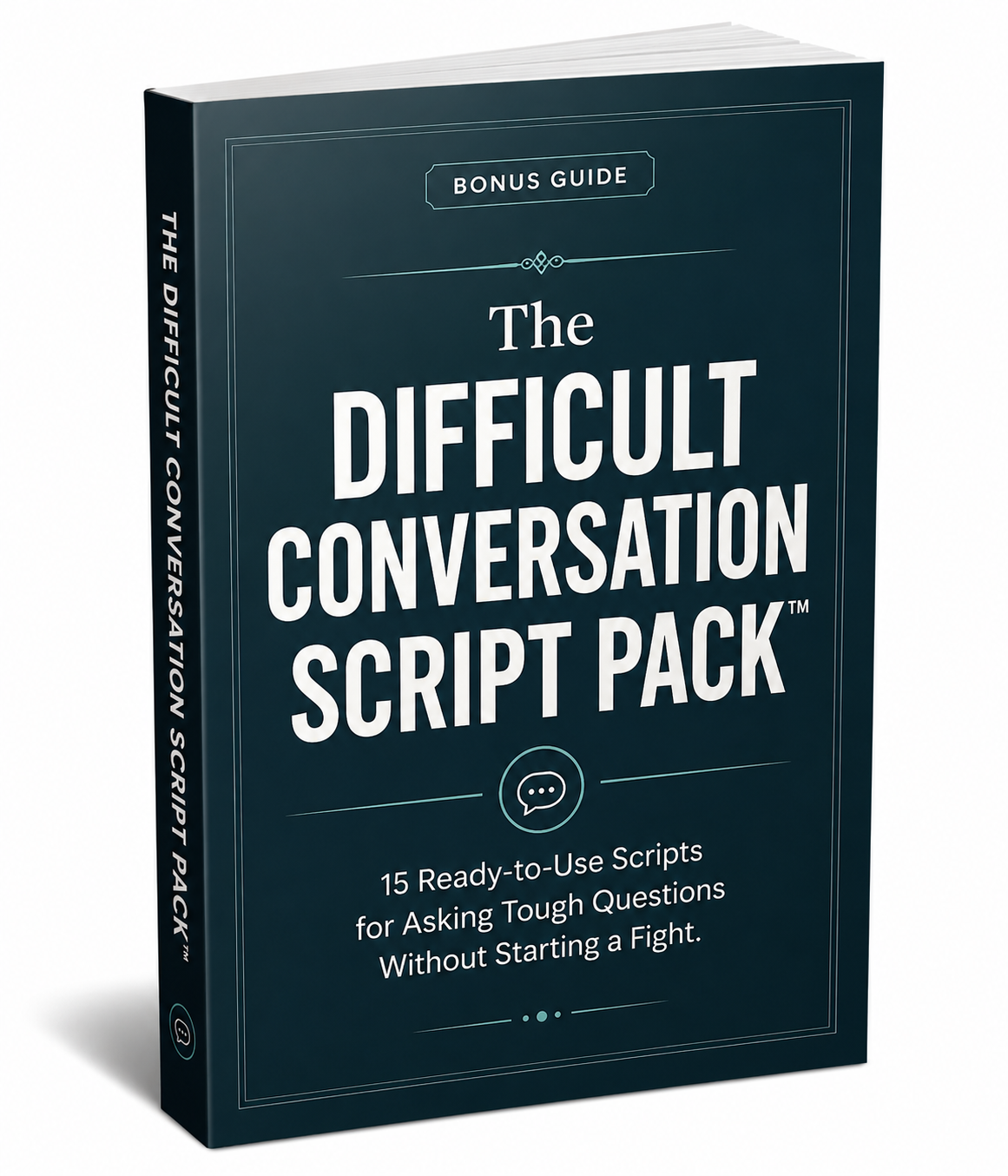
15 ready-to-use word-for-word scripts for asking the hardest questions — without starting a fight. Each script is paired with an explanation of exactly why it works. This is not about confrontation. It is about creating space for truth. Includes scripts for when he gets defensive, when he says you are overthinking, when stories do not add up, and when you need to set a boundary with love and firmness. The most important script of all is Script #15 — and it is just five words long.
Everything You Are Getting Today
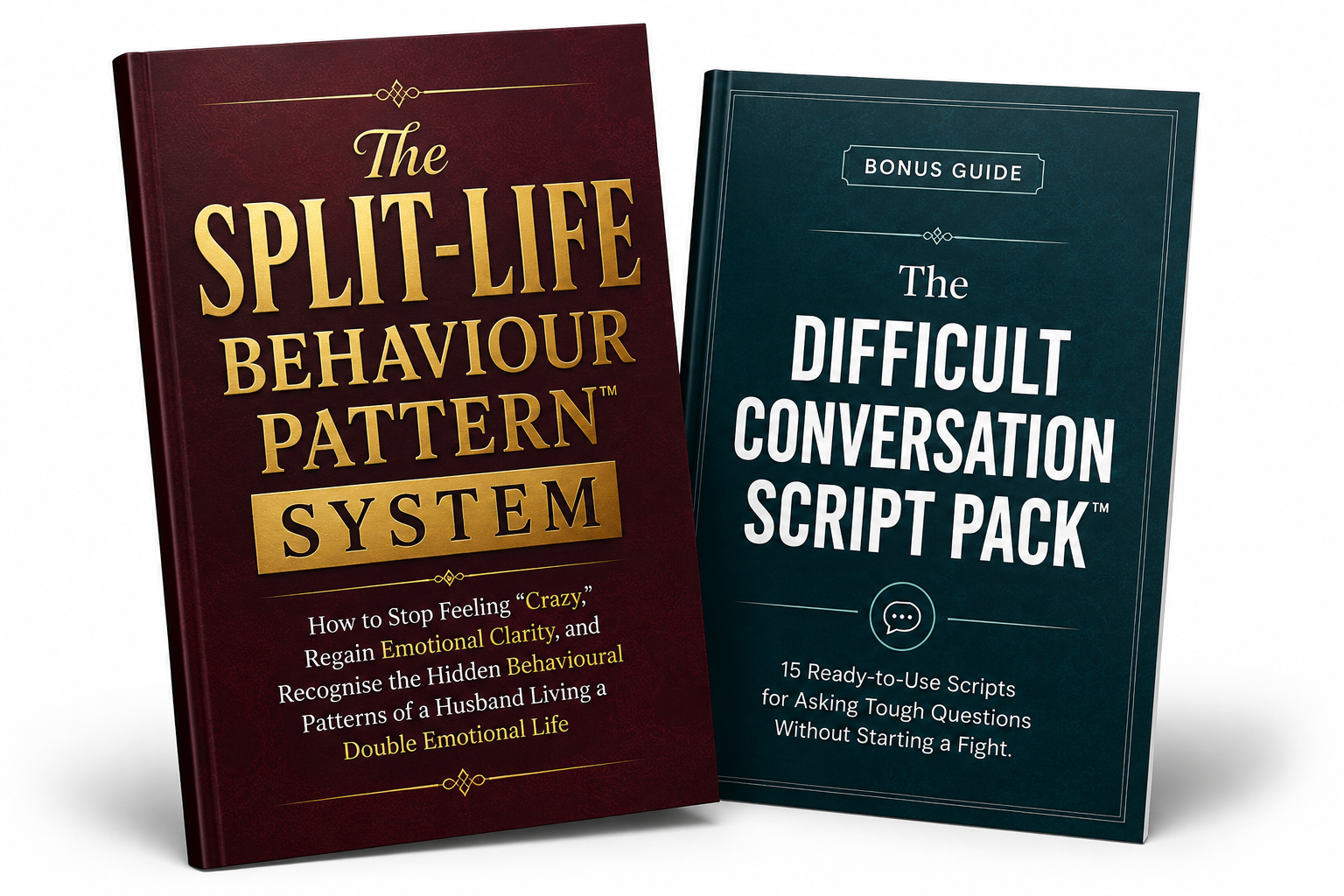
- The Split-Life Behaviour Pattern™ System —
₦13,000 - BONUS: The Difficult Conversation Script Pack™ —
₦5,000
Right Now, You Have Two Choices
If You Do Nothing
- The confusion continues. So does the self-doubt.
- You keep mistaking his patterns for random behaviour.
- You keep wondering if it really is all in your head.
- You keep adjusting yourself trying to fix something that is not yours to fix.
- Another year passes. Then another. And the woman you used to be gets further away.
If You Get the Guide Today
- You have the framework within 90 seconds of payment.
- You begin the observation method tonight, privately.
- Within days, the pattern becomes visible. The confusion begins to lift.
- You stop reacting and start seeing. That alone changes your posture in the marriage.
- You are no longer guessing. You know what you are dealing with. And you can decide from there.
🛡 30-Day Money-Back Guarantee
Follow the observation method for 30 days. Apply the framework exactly as it is written. If you do not experience measurable improvement in your emotional clarity — if you do not begin to see the patterns described — contact me and I will refund every naira. No argument. No questions. This is a promise, not a policy.
One Last Thing…
Picture yourself one month from today. You have applied the framework. You have completed the observation method. The patterns are visible. The confusion has lifted. You are no longer guessing. You are no longer rehearsing conversations in your head. You are no longer shrinking yourself, doubting yourself, blaming yourself for something you did not create.
Will you feel lighter?
Will you feel like yourself again — not the version that has been worn down, but the version that existed before the confusion began?
Will you walk differently through your own home?
Will you speak differently — not from fear, but from clarity?
Will the woman in the mirror finally feel familiar again?
Now picture yourself one month from today if you close this page. The confusion is still there. The self-doubt is still there. The patterns are still invisible. And everything that has been quietly eroding you — still eroding.
The difference between those two versions of you is a decision you make in the next sixty seconds.
MAKE THE DECISION. GET THE GUIDE NOW →If you have read this far and you are still hesitating —
Ask yourself honestly: what is the hesitation really about?
It is not the money. ₦6,500 is less than a family dinner out. Less than one counselling session that probably did not help anyway.
The hesitation is about whether you believe you deserve clarity. Whether you believe your peace of mind is worth investing in. Whether you believe you are worth fighting for — even quietly, even privately, even in this small way.
If you cannot invest ₦6,500 in your own emotional clarity — in your own peace, your own sanity, your own return to yourself — how do you expect your husband, or anyone else, to invest in you?
You have already given enough to this confusion. You have already paid enough in sleepless nights, in second-guessing, in the slow and quiet erosion of who you are.
Stop hesitating. Choose yourself.
YES — I CHOOSE MYSELF →P.S. — This guide comes with a full 30-day money-back guarantee. Follow the framework exactly. If your emotional clarity does not improve, I will refund you completely. You have nothing to lose except the confusion.
P.P.S. — This price of ₦6,500 is only available for the first 200 women. Once those spots are gone, the price returns to ₦13,000. Do not come back tomorrow and wonder why it costs more.
P.P.P.S. — Every day you wait is another day the confusion has power over you. Another day of doubting yourself. Another day of feeling like a stranger in your own life. That ends today, if you choose it to.
Frequently Asked Questions
How is the guide delivered?
Immediately after your payment is confirmed, the guide is sent directly to your WhatsApp number and your email address — within 60–90 seconds. You do not need to log in to any website or platform. It arrives like a message from a friend.
Are the methods in the guide easy to apply without any training?
Yes. The entire guide is written in plain language — not academic, not clinical, not complicated. Nnena wrote it specifically for the woman who is in the middle of this situation right now, not the woman who has years to study theory. The observation method begins on page 32 and you can start the same night you receive the guide.
What if I have been in this confusion for many years — is this still relevant?
Yes. Pages 95–112 contain the Extended Protocol specifically designed for women who have been inside the confusion for five years or more. The longer the confusion has lasted, the more the erosion has built up — and this section addresses that directly, with a deeper and more gradual process for rebuilding clarity.
What if my husband becomes suspicious or questions what I am doing?
The observation method is entirely private. You do not confront. You do not interrogate. You simply observe and note — in your own time, in your own space. There is nothing about this process that is visible to your husband. The Script Pack bonus also gives you language for managing those moments when he tries to deflect or accuse you of overthinking.
Is the 30-day guarantee real?
Completely real. Apply the framework for 30 days — follow the observation method, use the scripts, do the work as described. If your emotional clarity has not measurably improved, send a message and a full refund will be processed. No argument, no difficult process, no questions asked. The guarantee exists because the framework works when it is followed.
Why is this different from marriage counselling or the books I have already tried?
Most marriage resources focus on communication — on how you talk to each other, how you resolve conflict, how you express your feelings. This guide does something fundamentally different: it teaches you to recognise patterns of behaviour rather than reacting to individual incidents. That shift — from reacting to seeing — is what makes the confusion lift. No counsellor can see your marriage from the inside the way you can. This guide gives you the framework to see it clearly yourself.
Disclaimer: This guide is for educational and informational purposes only. It is not a substitute for professional psychological or legal advice. Results may vary based on individual circumstances.
Comments (847)
Leave a Comment